

Every home service business has a version of the same story. A crew that does great work, a reputation built over years, and somehow, jobs still slipping away to a competitor down the road who isn’t obviously better at the trade. Nine times out of ten, the answer isn’t the work. It’s the phone.
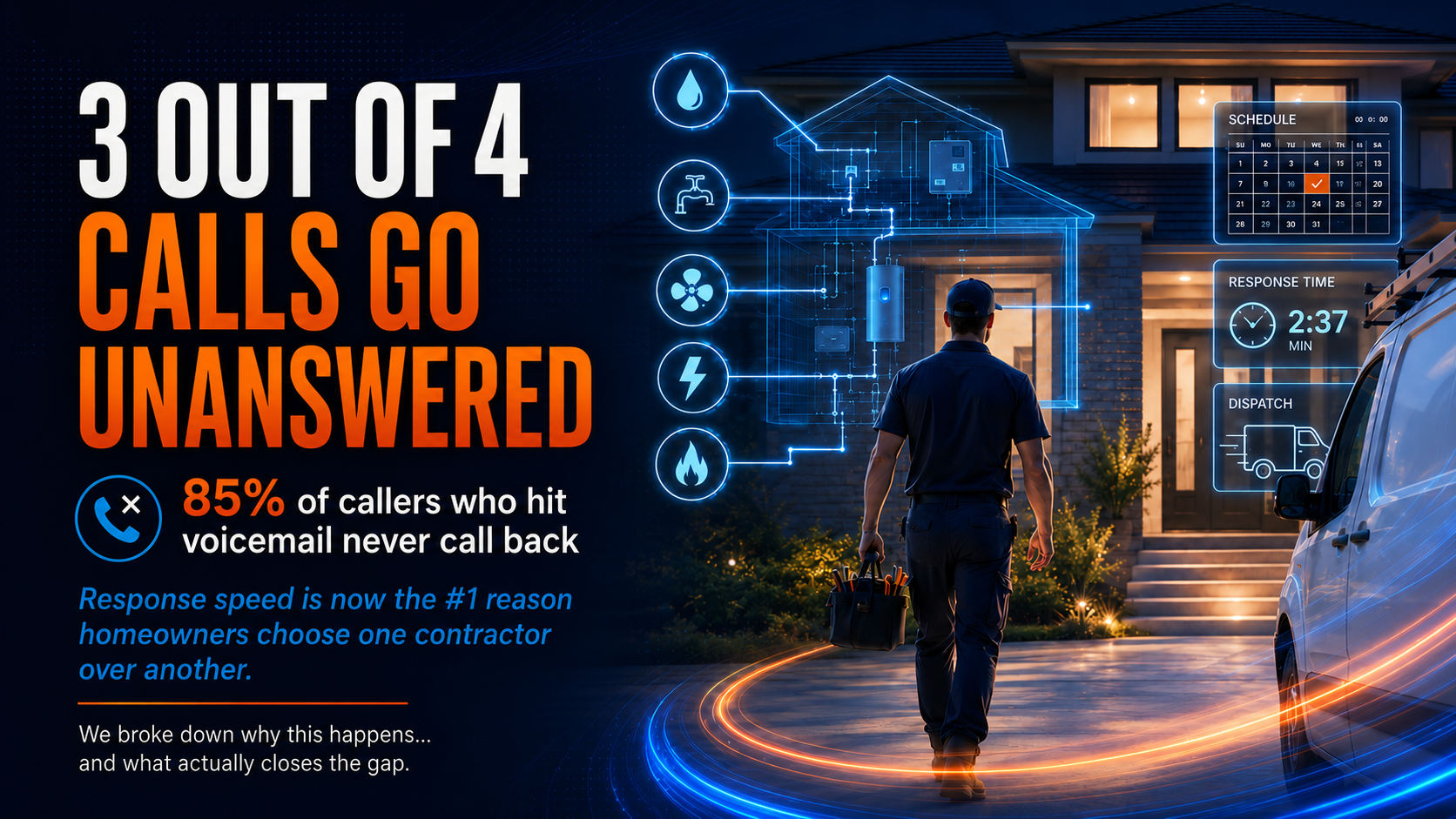
Three out of four calls to a home service business go completely unanswered. Not sent to a friendly voicemail and followed up later, just never picked up at all. And of the callers who do hit voicemail, 85% never call back. They call the next name on the list instead.
The Math Nobody Wants to Admit
Read that again slowly. Three out of four. That’s not a bad month or an unlucky week, that’s the baseline reality for most home service businesses, every single week, all year. And the 85% voicemail abandonment rate means the fix isn’t “call them back within the hour.” By the time most businesses get to a voicemail, the moment has already passed for the majority of callers.
This isn’t a knock on the businesses missing those calls. It’s a structural problem. You can’t be on a roof, under a sink, or driving between jobs and also be sitting by a phone waiting for it to ring. The irony is that the busiest, most in-demand businesses, the ones doing the best work and generating the most calls, are often missing the highest number of them, because being good at the job means being unavailable to answer for it.
Why Response Speed Beats Everything Else
Here’s the part that should really change how you think about this. 73% of homeowners now say response speed is the single biggest factor in choosing a contractor, ahead of price, ahead of online reviews, ahead of everything else people used to assume mattered most.
Think about what that actually means. A homeowner with a leaking pipe or a broken AC unit isn’t carefully comparing five quotes and reading through reviews before deciding. They’re calling down a list, and whoever picks up first and sounds capable is very often the business that gets the job, full stop.
It also explains why platforms like Angi, despite dominating lead volume with roughly 40% market share, carry close to 90% negative contractor reviews. Contractors are paying for leads and then losing them anyway, because the lead-gen platform gets them the phone number, but nothing about a shared-lead subscription helps them actually answer faster than the four other contractors who bought the same lead.
What Actually Closes the Gap
The businesses winning right now generally aren’t better at the trade than everyone else in their market. They’re just answering. Every time, live, without making the caller wait for a callback that might come after that homeowner has already hired someone else.
An AI voice agent solves this in a way a human receptionist realistically can’t, because it doesn’t need to sleep, take a lunch break, or be on another call. A well-built one answers every call live, sounds natural enough that most callers don’t think twice, hands off to a real person seamlessly when the conversation needs a human, and logs everything straight into the CRM so nothing falls through a crack between the call and the follow-up. The point isn’t replacing your team. It’s making sure the phone never rings into silence again, especially during the exact peak hours when you’re too busy doing the work to also be answering for it.
There’s a second layer to this that’s easy to miss. Answering the call is only step one, what happens in the thirty seconds after someone picks up matters just as much. A caller who gets a rushed, distracted “can you hold” is barely better off than a caller who got no answer at all, they’re still deciding whether to keep looking. A system built around this problem should be able to gather the basics, the type of job, the urgency, the location, book it directly onto the calendar if it’s straightforward, and flag anything that genuinely needs a human’s judgment before the crew even gets back to the shop. That’s the difference between “we technically answered” and “we actually captured the job.”
It’s Not Just Trades
This pattern shows up across every vertical we work in, just with a different shape. In Beauty + Wellness, about 40% of med spas now lean on AI for customer service and scheduling, and AI receptionists are recovering roughly 35% of missed calls where they’re in place, with AI-driven personalization lifting average booking size around 33% on top of that.
In Restaurant / Caterer, the shift is from being visible in search to being answerable the moment someone asks about availability, with 51% of restaurant marketers already using AI for video, 42% for images, and inquiries increasingly routing through chat and voice instead of a ringing phone nobody’s near.
In Professional + Creative, legal AI adoption jumped from 23% to 52% in a single year and accounting firm adoption sits at 73%, but 91% of those professionals admit their organizations are falling short of what the technology could actually deliver, adoption is running well ahead of a real plan.
And in Corporate + B2B, 63% of companies now use chatbots for lead qualification, with 71% of adopters reporting better lead quality as a result, conversational AI is doing for inbound leads exactly what a voice agent does for missed calls, catching what would otherwise slip away unanswered.
The Real Question to Ask Yourself
The question isn’t “do I need AI.” It’s simpler and harder to ignore than that: what actually happens to a customer when your business doesn’t answer? If the honest answer is “they call someone else,” you already know exactly what the fix needs to do.
Most owners have never actually run the numbers on their own call volume, they’ve just absorbed the missed calls as a normal cost of doing business, the same way you’d shrug off a slow week in bad weather. But a missed call isn’t weather. It’s a specific, countable moment where a customer who was ready to hire someone chose not to wait for you. Pull your own call log for a single week and count how many rang out, went to voicemail, or got picked up two rings too late. For most businesses, that number is uncomfortable, and it’s also the clearest case for fixing this that you’ll find anywhere in the business.

0 Comments